As BIM enables us to carry out analyses and explore optimisation options right from the very early stages, the integration of BIM and sustainability holds great promise for making construction not only more efficient but also more sustainable in the future.

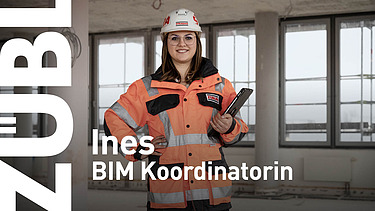
Ines
BIM Co-ordinator
Rudolf Froese / ZÜBLIN
Back to People at ZÜBLIN

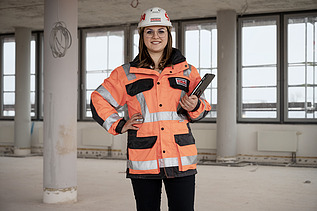
Ines is a BIM coordinator and team leader at ZÜBLIN.

Ines is convinced of the added value that BIM (Building Information Modelling) brings to the construction sector. This is because a collaborative approach can make the construction industry more efficient and productive, thereby preparing it for the future. In this interview, she tells us more about her career path at ZÜBLIN and the exciting areas of work within the field of BIM.

What exactly does the term ‘BIM’ stand for?

BIM is a project management method centred on data-driven planning and construction, and based on collaboration. It is underpinned by the BIM model – a Building Information Model – which contains not only 3D elements but also the relevant digital information. This BIM model is then used to carry out model-based processes. For example, it can be used to calculate quantities, draw up plans and simulate the construction process.


How did you come to be in the role you hold today?

My first contact with ZÜBLIN came during my bachelor’s degree in Civil Engineering. I initially completed my work placement in construction management for turnkey projects, and a little later I wrote my bachelor’s thesis at ZÜBLIN in the field of façade technology.  

After graduating, I started as a trainee in the Central Engineering department (ZT). During this time, I gained an insight into many different areas of the group and, in addition to a domestic construction site, was also able to work on a project in Lisbon for several months. I also gained my first experience of BIM methodology during the trainee programme.

Back in the Façade Engineering department, I initially worked in tendering and contract award, where I was immediately able to apply my newly acquired BIM skills to projects. I then spent some time in BIM development before, following an in-house training course, becoming a BIM coordinator.

I then began my Master’s degree in project management, which I completed whilst working as a specialist project manager on the US-Klinikum Weilerbach project. Since 2022, I have been a team leader in façade engineering, managing a team of over ten staff members.

  • I think it’s great that we get on so well and have such a good atmosphere in the team. You can really tell that we complement each other well and work hand in hand. The mutual support, appreciation and the occasional team event make us a brilliant team. And that’s partly what makes me look forward to coming in every day. 

What is the composition of your team, and how are the tasks within the department allocated?

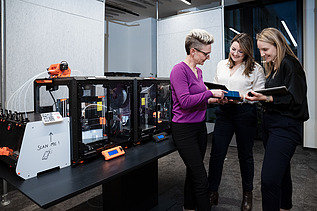
My team is responsible for BIM, generative design and sustainability within the façade engineering department. Within the team, we have various roles, such as BIM developers, BIM modellers and BIM coordinators. We are a team that works together, with a strong spirit of innovation, to realise the wide-ranging benefits of the BIM methodology in our projects. 

What lies behind these roles?

The BIM methodology is extremely diverse. This is precisely why BIM projects require BIM management that works with the client to assess what the requirements are and for what purposes the model is to be used. The BIM managers then plan how the project is to be implemented from a BIM perspective and document this in the BIM implementation plan.

This is where the BIM coordinators for the specialist disciplines – such as architecture, façades, building services, etc. – come into play. They are already involved in the BIM execution planning stage and provide specialist input. From this point onwards, they are the primary points of contact for the BIM discipline-specific model and are responsible for it. Among other things, they ensure that the BIM use cases can be implemented using the model. To this end, they usually support the project across several project phases and assist the project teams involved in tender processing, planning, tendering and execution with model-based project management. The various BIM coordinators from the specialist trades and the BIM managers work closely together. In this way, they deliver design and construction from a single source and work collaboratively and in a networked manner to ensure the project’s success.

BIM modellers play a particularly important role in model creation. They create the specialist models based on the documentation and incorporate the requirements into the models. To do this, they use digital components, amongst other things. These are provided by the BIM developers, who, in addition to the components, also develop model-based processes, working methods and templates. This requires a holistic approach, as the developments must, of course, meet the requirements of all project stakeholders. It is clear, then, that the individual roles work hand in hand like clockwork. We complement one another to get the very best out of every project together. 

What are your responsibilities?

As a team leader, I act as the point of contact for other divisions within the group on matters relating to BIM, generative design and sustainability. In this role, I support my team in implementing projects and developing new solutions and tools. I am currently focusing more intensively on the topic of sustainability, for which we are developing a range of tools and solutions. I see great potential here, particularly in combination with BIM, to make construction not only more efficient but also more sustainable in the future.

What makes your day-to-day work so exciting?

It’s quite clear: the variety. I get to work with a wide range of topics and people – from my own team, but also from across the entire group. Tackling ever-changing demands and challenges with a spirit of innovation, and devising solutions to make processes even better and more efficient – that’s what makes my job so exciting. 

What qualities should people starting out in their careers have if they are also interested in a job in the field of BIM?

If you’re interested in a job in the BIM sector, you should definitely have an interest in innovation and variety. You should be able to work both as part of a team and independently. Analytical and holistic thinking make the role easier. You should also have an understanding of the various processes within the design and construction value chain. 

In your view, what makes ZÜBLIN stand out as an employer?

When I decided to join ZÜBLIN back then, the main factors that influenced my decision were the exciting projects and the varied range of tasks within the group. Looking back now, I also find the opportunities for professional development exceptional. I’ve now had the chance to experience the group in various roles, and at every stage of my career so far I’ve found the environment to be very supportive and have learnt an incredible amount. In addition to practical experience, ZÜBLIN also introduces you to the various roles through a comprehensive training programme, ensuring you’re as well prepared as possible for your tasks. 

You can find more insights into the day-to-day work of a BIM coordinator in the video:

A close-up of a BIM coordinator wearing a hard hat.
BIM Co-ordinator at ZÜBLIN.