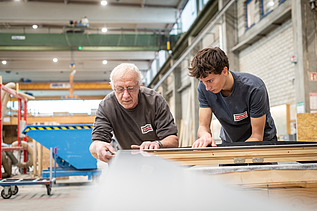
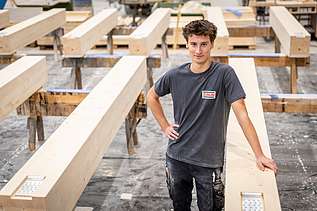
Many people are probably unaware that this profession is no longer just about working with wood, but that computer-controlled machines are also used.

Sebastian
Apprentice carpenter
Niels Schubert / ZÜBLIN
Back to People at ZÜBLIN

Sebastian is training to be a carpenter and talks about his experiences.

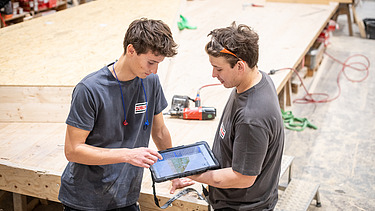
Sebastian is already taking on responsibility whilst still training as a carpenter. He enjoys hands-on work and appreciates being able to see first-hand the results of his efforts. He is particularly interested in large-scale timber construction projects. He takes pride in working on these and being part of the team.

What does the training period as a joiner involve?

The first year of the apprenticeship begins with the introductory year of vocational training, which includes a four-week work placement. After that, the actual apprenticeship begins: two years of hands-on experience at the factory, combined with block teaching at the vocational college and inter-company training. This ensures that theory and practice are optimally combined.
What are your responsibilities?

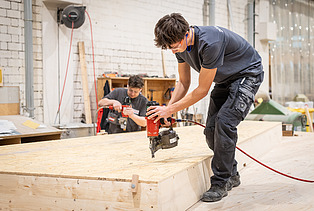
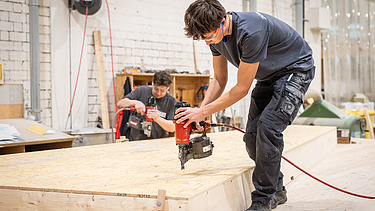
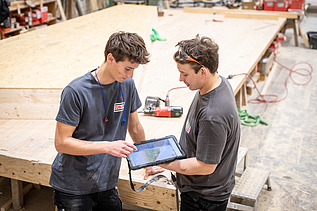
My duties are very varied. They include assembling wall and ceiling elements, hand-joining beams and columns, and cutting materials and panels to size. I also operate a crane, apply wood preservative and carry out the insulation, cladding and taping of the elements.

What do you like best about your training?

I particularly like the fact that I’ve been able to take on responsibility right from the start. I most recently spent two months working on the ‘Grüner Betriebshof Mannheim’ project, where I was even able to take on a small supervisory role on the so-called ‘butterfly turner’. At the automated turning station, which rotates timber construction elements quickly and safely through 180 degrees, I ensured that the materials were always available and that the processes ran smoothly.

During your training, are there people you can always turn to?

Yes, of course. The people I turn to are my trainers or the foremen on the current project. But if I have any questions, my colleagues are always willing to listen as well.

Why did you choose this particular piece of work? What makes it special to you?

Even as a child, I enjoyed working with wood. This became apparent early on when I started building my first birdhouses in my workshop at home. Today, I am particularly fascinated by large wooden structures. It makes me proud to be able to play a part in such projects and to see what is ultimately achieved through teamwork.

  • I inherited my passion for craftsmanship from my father. I’ve always enjoyed nothing more than creating things myself using machines, cordless screwdrivers and saws.

What is it that most people don’t know about your job?

Many people are probably unaware of just how modern our profession has become. It is no longer just about traditional craftsmanship with wood. A large part of the production process is now carried out using computer-controlled machines. Whereas in the past, timber was cut by hand, today machines such as the K2 take over much of this work and ensure the highest level of precision.

What do you see as the main challenge in your job?

Because new challenges await me every day in my day-to-day work, I cannot always prepare for my tasks in advance. As a result, my job requires a great deal of spontaneity, flexibility and the ability to come up with my own solutions. Added to this are the high quality standards set by our clients, which we aim to meet at all times.

If you could look into the future – where do you see yourself at ZÜBLIN Timber?

First of all, I’d like to complete my apprenticeship with a good result. After that, I’m planning to undertake further training to become a foreman, so that I can gain even more experience in my profession. But that wouldn’t be the only option open to me. I can also well imagine moving into an office role at a later stage to learn about the organisational side of things.

Meet Sebastian in the video and find out more about his training as a carpenter:

Sebastian, apprentice carpenter Niels Schubert / ZÜBLIN
Wood shapes the future: Training as a carpenter at ZÜBLIN