Quantity Surveyor on Lake Constance: Saikrishna on his linguistic, professional and technical development.
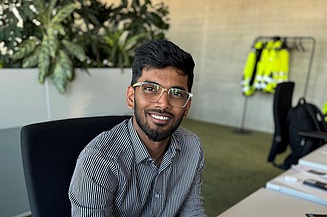
Hi Saikrishna, tell us: how did you end up in procurement at ZÜBLIN?
My journey into procurement at ZÜBLIN actually began quite pragmatically: I wanted to further my career in Germany and applied for a suitable role – without knowing which department would ultimately suit me best. The decision was then made during a discussion with my current line manager and the head of department.
Thanks to my work as a student trainee in Leipzig, where I spent a lot of time working on quantity take-offs and technical fundamentals, I already had a good understanding of components and quantity structures. Even though I was working without any specialised tools back then, the underlying methodology has remained the same. That was precisely a major plus point in the application process.
My current manager quickly realised that my technical understanding and my structured approach to working with figures were ideally suited to procurement. And today I can say: procurement is exactly the field where I really feel at home.
Throughout my career, the region I ended up in was never a deciding factor for me. What mattered most to me was the opportunity to develop further and receive proper induction. The fact that this path has led me to Lake Constance makes me particularly happy.
How was your onboarding at ZÜBLIN organised?
My onboarding at ZÜBLIN was superbly organised and, at the same time, very personable. From day one, I never felt left to my own devices. A key component was the contract award schedule, which provides an up-to-date overview of the status of all trades in the contract award process for each project. This gave me a clear overview of all areas of responsibility.
The team provided me with comprehensive support, both technically and in using the tools. And I can honestly say that my team supported me with an incredible amount of patience – even when I made mistakes or needed something explained to me several times. This support helped me enormously to feel confident and to develop my professional skills quickly.
What fascinates you personally about procurement?
What fascinates me most about procurement is the combination of technical understanding and financial responsibility. I appreciate the fact that my decisions have a direct impact on the project. You’re constantly liaising with project support/planning coordination, the site management team and many other stakeholders. This means you very quickly come to understand how a construction project really works.
What motivates me most of all is that you learn incredibly quickly in procurement. No two days are the same; every trade brings new challenges and new technical insights. For someone like me, who enjoys learning and developing, this is ideal.
In your opinion, what qualities do you need for your job?
In my view, working in procurement requires a mix of technical understanding, strong decision-making skills and a genuine willingness to learn. When I started at ZÜBLIN, my German was at B1 level. Thanks to the support of my manager and my team, I’ve been able to improve my German steadily. Today, I’m at C1 level and am continuing to learn so that I can keep developing my language skills.
This progress shows me every day just how valuable perseverance and a supportive environment are.
What do you find to be the most challenging part of the procurement process?
For me, the most challenging part of the procurement process is correctly interpreting technical ambiguities in the design documents. At times like these, I work with my team to develop practical solutions so that we can draw up a technically accurate and economically viable specification.
Another challenge is comparing the various technical specifications of the different products and identifying the best solution for the project. Every decision has a direct impact on costs, execution and quality. That is why it is essential to work with great precision and to consult regularly with the site management, the project management and the team.
Was there a project from which you learnt a great deal?
Yes, there were several projects – both in residential and industrial construction – from which I learnt a great deal. It was precisely this combination of different technical requirements that really helped me progress. In these projects, I had to work out many details myself, fill in gaps in the information and develop practical technical solutions in collaboration with the site management.
The mix of challenging trades, drawings and the need to draw up my own sketches or technical alternatives has accelerated my professional development enormously. I have learnt to make technical decisions with confidence, to formulate queries precisely and to find the best possible solutions together with my team and the contractors.
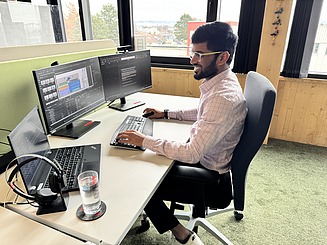
What sort of projects do you prefer to work on, and why?
At the moment, I prefer working on finishing works, as that’s where I draw up most of my specifications. For me, the finishing works sector is the ideal starting point, as I learn new technical details every day and can gain a very good understanding of the interrelationships between the different trades.
At the same time, I don’t want to limit myself to the fit-out phase alone. If the project and time allow, I’m already looking into the details of the structural work so that I can draw up specifications in this area in future as well. I’m looking forward to ‘spreading my wings’ and, step by step, taking on responsibility for structural work as well as fit-out.
What advice would you give to others who want to follow a similar path to yours?
My most important piece of advice is: don’t be afraid of the language. My own journey is a good example of this, and I’m still learning all the time. With the support of a good team, an understanding boss and the right attitude, anything is possible.
I’d also recommend:
Ask lots of questions. Nobody expects perfection, but everyone appreciates honesty and a willingness to learn.
Learn the trade step by step. Understanding the various trades takes time – but you’ll grow a little every day.
Seize every opportunity to take on responsibility. Even small tasks help you progress.
Stay open to different areas of work. I started in the finishing trade and am now working my way towards structural work. That’s exactly what makes the journey exciting.
Thank you for the interview and for sharing these insights into your remarkable journey. We wish you every success in the future!